Connect Earnings Supported Mariatu’s Business Expansion
How a Community Health Worker (CHW) in Kenema turned income from verified health services into seed funding to expand her business.
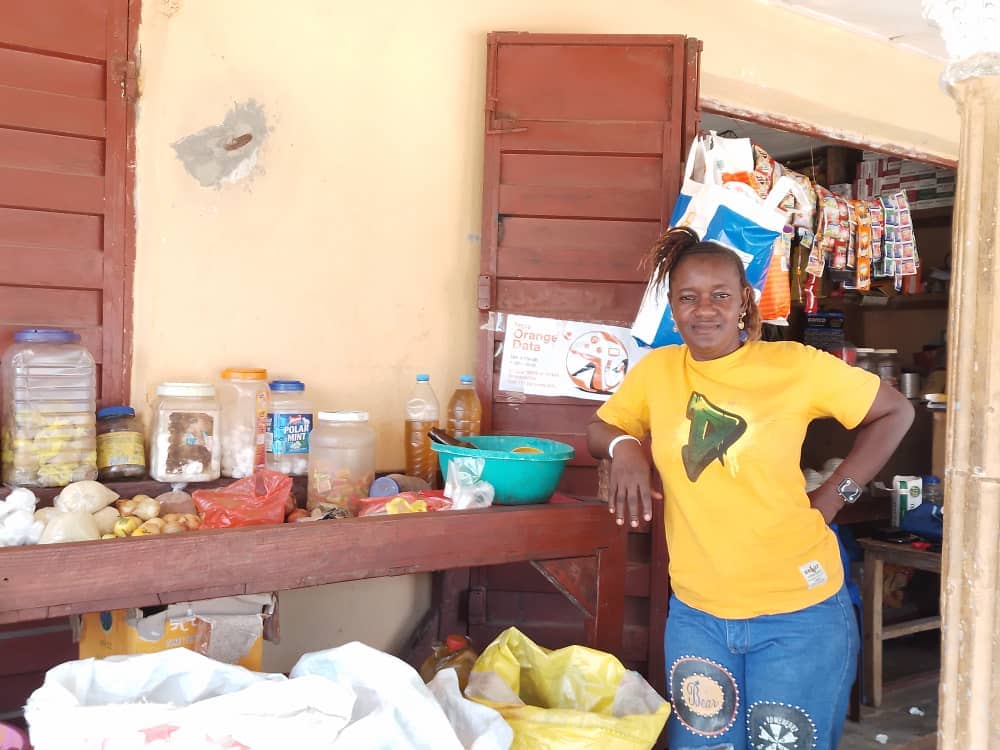
Mariatu knows how to make a small amount of money work hard.
In 2025, FOCUS 1000 recruited Mariatu to participate in a Child Health Campaign (CHC) with the Ministry of Health (MoH), supported by Dimagi. Mariatu was one of 17 community health workers (CHWs) trained and supported to deliver verified health services in selected communities in Kenema District, Sierra Leone. The project was delivered through Connect by Dimagi, a platform that links funding directly to services completed at the frontline. Mariatu used the payments she received from the project as capital for an Orange Money business, helping people in her community move between cash and mobile money. It was the second small business she had built.
From her home in Kenema, Mariatu already ran a provision shop selling everyday essentials such as rice, soap, cooking oil, seasonings and gas. She also sold mobile-phone recharge airtime top-ups, a service no one else nearby offered.
“I buy from the market, then sell it to the community,” she explains. “Where I am, we don’t have a big market, so most people buy around here. I sell for a profit to support my family.”
Alongside running her shop, Mariatu works as a CHW. She began volunteering at a nearby hospital before the hospital recommended her for CHW training. Today, she does most of her health work in the community. She visits homes, talks to parents, encourages the use of local health services, refers sick people to the hospital and looks for children who have missed vaccinations.
When Mariatu leaves for her community health work, her mother looks after the shop. Her two children sometimes help when they are not at school.
“I like working in the community,” she says. “Since I left school, I’ve been working as a CHW, so I’m used to working with the community now.”
For the past decade, Sierra Leone has been working to establish a system that consistently pays its community health workforce. However, the system is experiencing challenges in achieving this objective. According to FOCUS 1000, a national NGO, Sierra Leone has approximately 6,800 CHWs, but only around 2,400 are currently active. Maintaining an accurate payroll is difficult: workers leave, facilities identify replacements, and those replacements may not be added to the government database.
“These are among the issues that we are working to address through the FOCUS 1000, UNICEF and MoH CHW Programme, to be launched this year, 2026,” said Mohammed Bailor Jalloh, CEO, FOCUS 1000.
The Government of Sierra Leone has digitalised the verification of peer supervisors’ work; for other CHWs, such as Mariatu, verification remains largely manual. To confirm that they are active, CHWs who are not peer supervisors must submit reports for three consecutive months to their health facility. They complete paper forms, which peer supervisors and health facilities collect and compile before entering the information into the national health information system. This delays CHW payments.
“Sometimes it takes two months, sometimes three, before we are paid,” says Mariatu.
Through the Child Health Campaign delivered by FOCUS 1000 using Connect, Mariatu visited communities to find children who had missed routine services. She checked children for malnutrition, provided health education, vitamin A and deworming treatment, and recorded each service on her phone.
She found the Connect app straightforward to use. More importantly, its digital verification system showed her what work had been recorded and what she had earned.
“It was really transparent,” she says. “If you register ten children for the day, the app tells you how many children you registered,” she explains. “There’s an area where you see how much you’ve worked and how much you’ve already made for the week or month.”
Instead of simply restocking her shop or putting the money into savings, Mariatu saw an opportunity to grow her business. She used her CHC earnings to add an Orange Money service to her provision shop, creating a new income stream.
“It was a great impact,” she says.
Today, Mariatu runs the Orange Money service alongside her provision shop, while continuing her work as a CHW.
Connect links funding directly to verified service delivery through trusted local organisations such as FOCUS 1000. Funders can see what their investment delivered, while frontline workers can see what work has been recorded and what they have earned.
For Mariatu, Connect provided greater transparency and increased her trust in the system. Her earnings then continued to generate value after the campaign ended: they became capital for a second business, providing another source of income and motivating her to continue her work as a CHW. In this way, payment for delivering essential health services helped Mariatu strengthen her livelihood while continuing to serve her community.