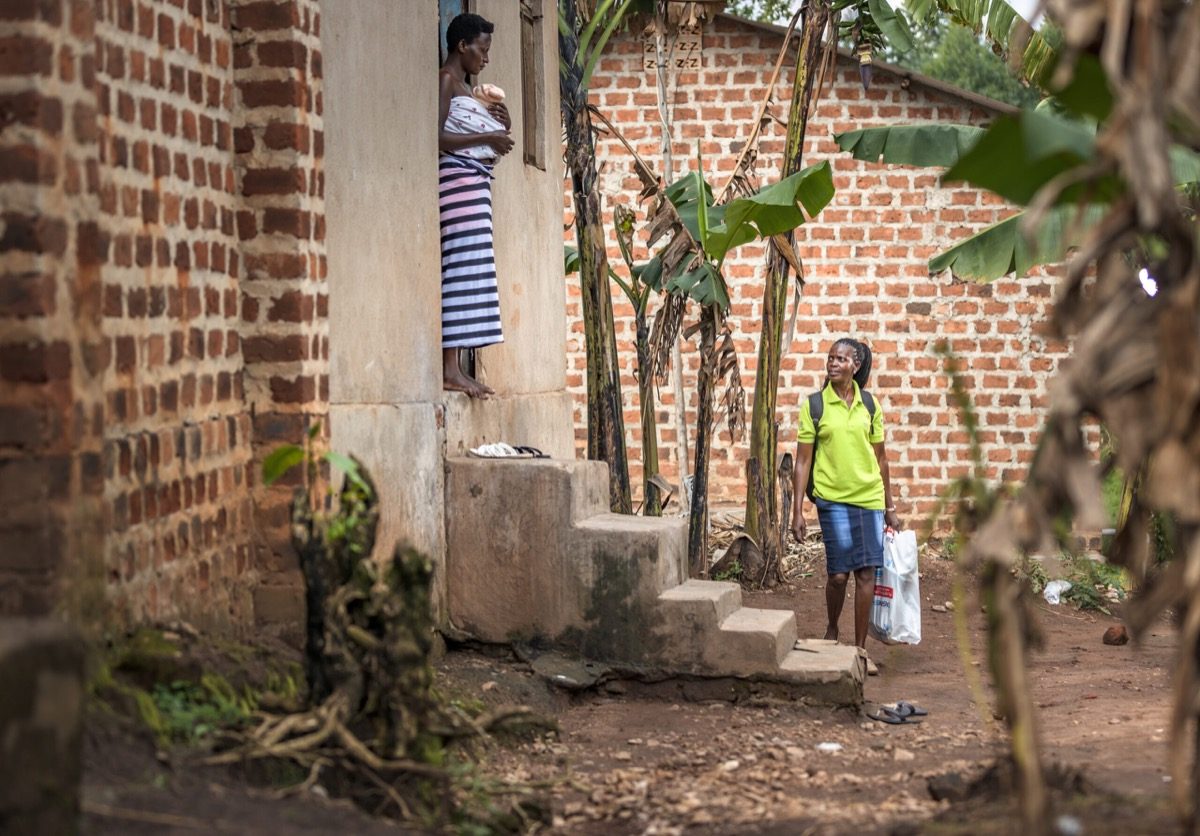
No intervention pays as much as the Connect Child Health Campaign. I could locate my beneficiaries and deliver services effortlessly.
Zarah Abubakar
RUWOYD
Pick the program, geography, and amount. Frontline Workers deliver in their own communities, paid only for verified services. Everyone sees the results.
Verified
For decades, funders have paid for planned activity and hoped it added up. Connect pays for work delivered, not work promised.
No intervention pays as much as the Connect Child Health Campaign. I could locate my beneficiaries and deliver services effortlessly.
Zarah Abubakar
RUWOYD
Payments through Connect have enhanced productivity. Frontline Workers feel valued, supported, and motivated.
Lawan Alhaji Kabu
ZEGCAWIS
It saves a lot of time and the child is helped at the right time. We are very grateful.
Bonface Musyoka
Watch the story
One of the most innovative tools we've used. The built-in verification means we can finally trust the data.
Oluwabori Samuel
Solina
Putting it all into one package is unique, from start to finish. This has everything.
Ibraheem Otieno
GlobCom
Knowing payments are linked to verified services delivered encourages our team to give their best and reach more people in need.
Dr. Stephen John
Janna Health Foundation
Every verified result translates into timely payments and measurable impact for malnourished children.
Aminu Ayuba
EHA Clinics
Working with Connect has been a rewarding and exciting experience. The teams are resourceful and relentless until solutions are found.
Ibrahim Mustapha
AHTI
Working with Connect has made our field work easier. Everything is organized and transparent.
Usman Musa
RAWYOD
Connect has redefined how community interventions are delivered. It is dynamic and unique.
Mathew Oladele
ISODAF4Africa
The in-app chatbot is unlike anything I've seen, and because every result is verified, we can finally trust the work was done.
Jaafar Lawal
C-WINS
Dig into the programs running on Connect today, what we’re learning along the way, and how frontline organizations join the network.
From Kangaroo Mother Care to Child Health Campaigns to Mental Health, explore the high-impact interventions running on Connect today, and the places they reach.
See the portfolio → InsightsConnect is as much a learning system as a delivery one. See what’s working, what isn’t, and how the model keeps shifting in response.
Read the insights → Frontline NetworkLocal, government-aligned organizations deliver every Connect program. Your frontline organization brings the relationships and delivery capacity; Connect brings funding and technology.
Join the network →Whether you’re funding a new campaign, designing a program, or running services on the ground, let’s see if Connect fits.
Pick the program, geography, and amount. Connect activates local organizations, verifies every service, and pays only for what’s confirmed.
Connect finds and activates qualified, locally-based frontline organizations. Within days, workers are deployed and delivering in the field.
Before anyone delivers a service, they train. Workers move through comprehensive digital training and must pass a certification test before they’re cleared to deliver services in the field.
Locally Led Organizations know their communities best. Connect provides the app, verification, and payment system, while organizations bring the relationships, supervisors, and trust.
Verify every visit the moment it happens. No manual reviews, no delays, no fraud.
Once services are verified, the worker receives a mobile money payment to their phone. Connect charges a 20% program management fee, with remaining 80% funds going directly to the frontline.
Funders track exactly what was delivered, where, and at what cost, paying for outcomes not effort. Frontline Workers see their verified service record, earnings, and reputation grow with every visit.
Connect is live across 13 countries. Whether you’re funding a campaign, designing a program, or delivering services on the ground, let’s see how Connect can work for you.
Get in touch →Stories, evidence, and learnings from the organizations and Frontline Workers delivering verified services through Connect.
Trained Frontline Workers carry Kangaroo Mother Care into the home, closing the dangerous gap that opens when families of small and vulnerable newborns leave the hospital.
Read more →
A new grant will scale and rigorously evaluate Connect, delivering Vitamin A and oral rehydration solution to children where coverage is lowest.
Read more →
GiveWell has awarded Dimagi more than $1 million to scale verified child health delivery across northern Nigeria, funding over 300,000 visits in 18 months.
Read more →
Across seven countries, Frontline Workers delivered more than 100,000 verified services, a foundation for scaling to millions of visits a year.
Read more →
The first year of designing and testing Connect: 77,000 clients reached, $161,000 paid to Frontline Workers, and the learn, deliver, verify, pay model proven in the field.
Read more →Every entry here is published in a funder report, an independent evaluation, or a public partner document, and has been judged honest, scoped, and worth putting on the public record. Underlying reports are available to funders and researchers on request.
In adversarial testing we paid Frontline Workers to generate fake data with financial rewards for those who did best. A model trained on three data fields hit AUC 0.91, detecting 100% of fake Frontline Workers while only flagging 2.5% of real Frontline Workers as suspicious.
Without a grid, Frontline Workers cherry-picked easy houses. With a grid forcing them to go door-to-door, the hardest-to-reach children stopped being the ones who got missed.
That figure is Connect’s all-in cost per visit, including commodities, LLO payments, setup, and product cost. The biggest driver of the drop was setup costs falling from ~$0.40 to ~$0.10 per visit as we moved past early-stage inefficiencies. We report cost-per-verified-outcome rather than cost-per-worker-trained because it’s the number that actually matters.
Past reputation, team size, references, none of it told us if a partner organization would actually deliver. So we contracted small first. Of 37 partners, 24 ran trial runs. 10 underperformed. 3 were selected to scale based on their performance.
Locally Led Organizations independently mobilized imams, pastors, village elders, and community-recommended Frontline Workers. The platform didn’t teach this, they already knew.
Remote coordination worked across Nigeria, Kenya, Uganda, Tanzania. It didn’t hold in the Central African Republic. Staffing turnover and connectivity issues exited both contracted partners.
If missing the window cost a worker money, we’d see suspiciously perfect compliance instead. So we treat it as a guardrail, not a payment criterion. We coach and integrate hospital discharge notifications to close the gap.
The headline 50% number understates the gap. The mean is 6.05 days. One delivery opportunity doesn’t collect hospital discharge dates at all, so 100% of those records are blank on this metric, which means the real-world bottleneck is data plumbing, not worker effort.
The Ministry is participating in working groups, quarterly reviews, and site visits, and contributing data to Uganda’s five-year national neonatal plan. The next step: government co-funding at $10-20 per case.
That covers partner engagement, the Kangaroo wraps, scales, thermometers, pulse oximeters, training, payment per verified case, and supervision. We picked it for our first individual-giving experiment because $60 is the smallest unit at which one donor can fund a complete intervention with verified delivery.
Workers who passed our digital test still struggled with nuanced in-home counseling. No single layer of training was sufficient. This improved with 78% of workers scoring above 80% during their first observed visits. Average performance increased from 85% to 91% in the second observed visit.
A 50-caregiver baseline showed near-universal endorsement of responsive caregiving. Attitudes weren’t the gap. Knowledge and observed teaching practice were, and that’s where we saw movement. We doubled the visit cadence in the next round.
Autonomy encouragement requires consistent behavior change across many interactions, not a single coaching session. It’s the sub-domain least moved by the current visit structure. We aim to expand from 3 to 8-10 visits per child specifically to give this target more runway. We don’t know yet if it will be enough.
Nothing matches those filters.
Whether you want to hear more about a program or dig into the evidence behind it, we are glad to talk. Reach out and we will share more.
Get in touch →Connect powers a growing portfolio of active programs and countries, with new ones of each added all the time.
Door-to-door vitamin A, deworming, oral rehydration solutions, malnutrition screening, immunization promotion for children under five.
Home visits for small and vulnerable newborns after hospital discharge. Closes the follow-up gap with 4 to 5 visits in the first 60 days.
Breastfeeding promotion (6 visits, antenatal through complementary feeding) plus mental health coaching via WHO’s Problem Management Plus.
Door-to-door near-vision screening and glasses distribution. Self-paced, digital training to efficiently upskill Frontline Workers.
Three parenting visits over three weeks to coach responsive caregiving and positive parenting within the nurturing care framework.
Local facilitators lead evidence-based group therapy through app-guided, verified sessions that help treat depression.
Chlorination can reduce childhood diarrhea by ~40%. This program provides communal water dispensers and door-to-door safe water education.
Frontline Workers deliver and verify home-based malnutrition treatment with guided dosing of ready-to-use therapeutic food (RUTF).
Frontline Workers are trained as a rapid research network using AI-guided interviews to deliver transcripts and summaries in two weeks.
Frontline Workers are trained as enumerators to conduct GPS-guided household surveys using satellite building footprints for sampling.
Have an idea for a new program? We co-design, deploy, and verify new interventions together with funders and organizations. We’d like to hear it.
Fund specific, verified service deliveries: a child vaccinated, a mother coached, a newborn attended to. Every dollar linked to a confirmed service delivery.
Door-to-door delivery of high-impact health services to every child under five, verified visit by visit and paid only for what’s confirmed.
A Child Health Campaign is a coordinated push where Frontline Workers move household-to-household across a defined area, delivering a bundle of high-impact services to every child under five they reach. Every service is logged, photographed, and independently verified before payment.
Vitamin A is one of the cheapest ways to save a child’s life: roughly $1 per capsule, with an estimated 4-12% reduction in under-five mortality. The hard part isn’t the capsule. It’s reaching the children. That’s what Connect campaigns are built to do.
Source: GiveWell ↗Albendazole or Mebendazole for children with soil-transmitted helminth exposure. Routine deworming improves nutritional status, school attendance, and growth in high-prevalence areas.
Distribution and caregiver coaching on ORS, one of the highest-impact, lowest-cost diarrhea responses in low-resource settings.
Mid-Upper Arm Circumference (MUAC) measurement and visual assessment for wasting. Children with red or yellow readings are referred into the local treatment pathway. Data flows back to inform the next campaign cycle.
Caregiver counseling on routine immunization, with referral to the nearest catch-up site. Several partners independently mobilized faith and community leaders to drive coverage.
Frontline Workers from Kikapu Gardens, a Locally Led Organization in Kenya, walk through their day delivering Child Health Campaign services with Connect. Trained workers visit households door-to-door, providing vitamin A, deworming, and malnutrition screening to children under five.
Hear from the organization’s staff, the workers themselves, and the families whose children received care.
Child Health Campaign is the program where most of Connect’s methodology was first validated. A few of the published findings:
That figure is Connect’s all-in cost per visit, including commodities, LLO payments, setup, and product cost. The biggest driver of the drop was setup costs falling from ~$0.40 to ~$0.10 per visit as we moved past early-stage inefficiencies. We report cost-per-verified-outcome rather than cost-per-worker-trained because it’s the number that actually matters.
Past reputation, team size, references, none of it told us if a partner organization would actually deliver. So we contracted small first. Of 37 partners, 24 ran trial runs. 10 underperformed. 3 were selected to scale based on their performance.
Locally Led Organizations independently mobilized imams, pastors, village elders, and community-recommended Frontline Workers. The platform didn’t teach this, they already knew.
Let’s build one together, starting with your desired geography and budget. We’ll come back with a delivery plan, a cost-per-verified-visit estimate, and a list of frontline organizations to run with.
Let’s Design Your Program80% of neonatal deaths happen after discharge, at home, without follow-up. Connect KMC closes that gap with structured home visits for small and vulnerable newborns in their first 60 days, verified and paid only when confirmed.
Each home visit is a structured clinical encounter. Frontline Workers arrive with a scale, thermometer, pulse oximeter, and measuring tape. They assess weight, axillary temperature, respiratory rate, oxygen saturation, head circumference, and feeding. Danger signs trigger an automated referral before the worker leaves.
Workers deliver Kangaroo wraps and nutritional support, position the newborn skin-to-skin, and observe a breastfeed. Feeding difficulty is one of the earliest signals of clinical deterioration in small newborns. Mothers also receive emotional support. Many face stigma and isolation after a high-risk birth.
Calibrated scale used at every visit. Weight-for-age tracking identifies faltering growth before it becomes acute malnutrition. Workers log the reading directly into the app and flag any drop from the prior visit.
Axillary temperature measured at every visit. Hypothermia is the leading preventable danger sign in small and vulnerable newborns. Any reading outside the normal range triggers an immediate referral pathway in the app.
Pulse oximeter reading captures respiratory status at each visit. Low saturation is an early indicator of distress before visible symptoms appear. The reading is logged alongside respiratory rate and breathing observation.
Structured checklist covering convulsions, jaundice, difficulty breathing, poor feeding, hypothermia, and abnormal skin color, with automatic referral generation when any is flagged. Workers do not leave until a referral plan is confirmed with the family. Facility linkages are pre-established.
When Nantume Madrine’s premature baby was discharged from a hospital in Mukono District, Uganda, she had almost no support. A Nama Wellness Center Frontline Worker enrolled her in Connect KMC within days. The baby thrived.
Nama Wellness Center trained 10 community health workers and reached 64 mother-baby pairs in Mukono in the first weeks of launch. Their post reads: "This is more than data. It is life, dignity, and second chances."
Two Ugandan partner organizations have now committed to delivering Connect KMC to an additional 5,000 Severely Vulnerable Newborns over the next year, expanding from Central Uganda into Eastern Uganda, with Uganda’s Ministry of Health signing an MoU targeting 50,000 Severely Vulnerable Newborns nationally over two years.
KMC is the program where Connect first applied outcome-based payment to newborn health. A few of the published findings:
If missing the window cost a worker money, we’d see suspiciously perfect compliance instead. So we treat it as a guardrail, not a payment criterion. We coach and integrate hospital discharge notifications to close the gap.
The headline 50% number understates the gap. The mean is 6.05 days. One delivery opportunity doesn’t collect hospital discharge dates at all, so 100% of those records are blank on this metric, which means the real-world bottleneck is data plumbing, not worker effort.
That covers partner engagement, the Kangaroo wraps, scales, thermometers, pulse oximeters, training, payment per verified case, and supervision. We picked it for our first individual-giving experiment because $60 is the smallest unit at which one donor can fund a complete intervention with verified delivery.
$60 covers the full Connect KMC cycle for one small and vulnerable newborn: Kangaroo wraps, scales, thermometers, pulse oximeters, Frontline Worker training, payment for visits, and supervision. Every dollar is tied to a verified outcome. Individual donors, foundations, and program funders all welcome.
You can help deliver it. Each year, 2.3 million newborns die in their first month of life. Kangaroo Mother Care, simple skin-to-skin contact and breastfeeding support, can reduce that risk by up to 40%.
Imagine a baby born too small and too soon, fighting for every breath. Leaving the hospital is just the beginning of a perilous journey, and families often lack the support to help them survive and grow.
There is a powerful, proven solution: Kangaroo Mother Care, a simple practice of skin-to-skin contact and breastfeeding support that can reduce mortality in premature babies by up to 40%.
But the challenge isn't the solution, it's delivering it. Kangaroo Mother Care coverage remains below 5% for eligible infants worldwide, leaving millions of newborns at risk.
This is where you come in.
Your support sends a trained, local Frontline Worker, often a woman from her own community, directly to a new mother's home.
We make this possible through our mobile platform, Connect by Dimagi. Think of it as the direct link between your generosity and that mother's doorstep. It ensures every Frontline Worker is paid for her life-saving work and that every dollar you give is tied to a verified visit.
Frontline Workers use Dimagi's Connect app on a simple smartphone to complete training on Kangaroo Mother Care, deliver services, and receive payments for verified delivery.
With the Connect KMC app, Frontline Workers are equipped with the knowledge to:
This model combats the community stigma often faced by mothers of premature babies by pairing families with a trusted mentor for essential support and encouragement.
We believe in trust through transparency. Our Connect platform ensures your generosity creates real-world impact you can count on. Here's how:
Your donation trains a local Frontline Worker and gives her life-saving tools, a digital app and essential supplies to support mothers and newborns.
A trained Frontline Worker visits a new mother at home, providing expert guidance, checking the baby's health, and offering compassionate support.
Using her phone, the worker confirms the visit, verifying that the baby was checked and the mother received essential support. It's how we ensure your gift makes a real impact.
Our approach is designed to be simple, effective, and scalable. We invest in local Frontline Workers, providing them with the training and fair pay needed to deliver proven newborn care directly in a family's home.
This efficient and effective framework is ready to grow. Your support helps us expand this vital work to thousands more families in new communities and countries.
We recently tested the power of this community-led model in a pilot program in Uganda. The results showed its incredible potential for rapid deployment:
In just eight weeks, our partners reached and provided care for more than 650 small and vulnerable newborns.
When you fund a Frontline Worker, your impact is multiplied across an entire community. That means:
This is a sustainable, community-powered solution that changes futures.
Your gift provides the training, tools, and support a Frontline Worker needs to deliver this life-saving care.
This foundational gift funds the complete cycle of Kangaroo Mother Care support for one vulnerable newborn and their mother, from the first home visit to a healthy start in life.
DonateYour gift supports three newborns and their mothers, allowing a Frontline Worker to build a trusted relationship and deliver consistent, life-saving guidance within her community.
DonateThis gift equips a Frontline Worker with the tools, transport, and fair pay to support 10 babies. You are creating a powerful ripple of change and ensuring an entire cohort of vulnerable newborns receives care.
DonateThis transformative gift provides a full caseload to a Frontline Worker for six months, enabling her to support 30 babies and their mothers, dramatically improving the survival rate for premature newborns across an entire village or neighborhood.
DonateYour generous gift of any amount will directly support a Frontline Worker and the families in her care.
DonateDonations to Connect Kangaroo Mother Care are made through Players Philanthropy Fund, a registered 501(c)(3) non-profit serving as fiscal sponsor. All gifts are tax-deductible to the extent allowed by law.
Yes, your gift is tax-deductible to the extent allowed by law. Our fiscal sponsor, Players Philanthropy Fund (PPF), is a registered 501(c)(3) organization. You will receive an email confirmation from PPF after your donation is processed, and tax receipts will also be provided at a later date for donations over $250.
Your donation directly funds the cost of delivering care to a vulnerable newborn. This involves a trained Frontline Worker who identifies an at-risk baby at a health facility and then makes regular home visits for the next 1–2 months of the child's life. During each visit, she spends valuable time counseling the mother and other caregivers and screens the child for any danger signs. A gift of $60 covers the full program for one baby, which includes:
Currently, our Kangaroo Mother Care program is active in Ethiopia, India, Kenya, Nigeria, and Uganda. We are focused on sustainable growth and are in the process of expanding to additional countries. Your generous donation supports our work across all regions.
This is what makes our model different. The Connect platform uses digital markers like GPS data and timestamps to verify that a Frontline Worker was at the right place at the right time, and that quality care data was submitted. This allows us to pay for proven impact with confidence.
If you'd like to learn more about the Kangaroo Mother Care program or have any questions about your donation, please contact us at connect-kmc@dimagi.com. We're happy to provide additional information.
While Dimagi is a for-profit social enterprise, all donations received are exclusively dedicated to charitable programs. To ensure that your contribution directly supports its intended cause, we partner with Players Philanthropy Fund (PPF), a registered 501(c)(3) non-profit fiscal sponsor. PPF is responsible for the management and allocation of these funds to program activities.
Home visits supporting responsive caregiving and early child development. Multiple structured visits building caregiver knowledge, observable teaching behavior, and child autonomy.
Each visit is a structured caregiver coaching session. Frontline Workers guide parents through responsive interaction, model talk-and-play activities, discuss developmental milestones, and practice teaching behaviors with the caregiver. The intervention targets knowledge and observable behavior.
Structured guidance on noticing and responding warmly to a child’s cues. Workers use scenario-based coaching to build the habit of responsiveness across feeding, play, and daily routines, not just during the visit itself.
Language-rich interaction and age-appropriate play activities for cognitive and language development. Workers model activities with available household materials, no kit required, and coach caregivers to continue between visits.
Knowledge building on what children are developmentally capable of at each age, and what caregiver behavior supports progression. Caregiver knowledge of rapid development timing improved 33% in the Malawi pilot.
Observed teaching behavior improved 21% in the Malawi pilot. Workers do not just explain. They watch caregivers practice, give feedback, and code the quality of what they see using a structured visit checklist.
Supporting children’s exploration and independent problem-solving. This is the hardest sub-domain because it requires pattern-based behavior change across multiple interactions, not a single coaching session.
An in-app AI coach built on Dimagi’s Open Chat Studio platform reinforces learning between visits. The coach runs daily: presenting practice scenarios, identifying knowledge gaps, and drilling motivational interviewing techniques like open-ended questions and reflective listening. At the end of each day it asks about how visits went and provides tailored feedback grounded in real experiences.
ECD is the program that most challenged our assumptions about what intervention design needs to target. A few of the published findings:
A 50-caregiver baseline showed near-universal endorsement of responsive caregiving. Attitudes weren’t the gap. Knowledge and observed teaching practice were, and that’s where we saw movement. We doubled the visit cadence in the next round.
Workers who passed our digital test still struggled with nuanced in-home counseling. No single layer of training was sufficient. This improved with 78% of workers scoring above 80% during their first observed visits. Average performance increased from 85% to 91% in the second observed visit.
Autonomy encouragement requires consistent behavior change across many interactions, not a single coaching session. It’s the sub-domain least moved by the current visit structure. We aim to expand from 3 to 8-10 visits per child specifically to give this target more runway. We don’t know yet if it will be enough.
Let’s build a program together, starting with your target geography, age group, and budget. We’ll come back with a delivery plan, a cost-per-child estimate, and a partner list.
Let’s Design Your ProgramDoor-to-door near-vision screening and presbyopia correction across northeast Nigeria.
A Reading Glasses visit is a two-part encounter: near-vision screening first, then distribution. Frontline Workers screen adults aged 35 and older with a paper E-chart, identify the appropriate correction strength from five dioptre options, dispense the pair, and photograph the completed distribution for independent audit.
Paper E-chart test administered door-to-door to identify presbyopia in adults aged 35 and older. Standardized distance and lighting conditions are part of the certification protocol. Pre-training test averaged 36/100; post-training averaged 93.5/100.
Five correction strengths available: +1.0, +1.5, +2.0, +2.5, and +3.0 dioptres. Workers test each beneficiary with the E-chart at the appropriate reading distance to identify the correct strength before dispensing.
Off-the-shelf reading glasses in the matched dioptre strength, handed directly to the beneficiary. Vision correction has been shown to increase work productivity up to 22% and income up to 33% for adults in visually-intensive occupations.
Every completed distribution is photographed live in the app. Photos are compared against specified criteria to ensure appropriate distribution.
Four self-paced digital modules, an 80%-threshold in-app test, then a two-day in-person practical evaluation.
GlobCom, endorsed by the Siaya County Ministry of Health, deployed Community Health Promoters (CHPs) across their existing catchment areas in November–December 2024. 25 of 32 enrolled CHPs completed self-paced digital training and in-person certification before delivering services. A daily cap of 5 distributions kept incentives aligned with CHPs’ existing core health duties.
1,387 household visits. 1,239 verified distributions. The platform flagged 26 duplicate registrations and rejected 30 shortened visits before payment was processed. Workers were paid 17–32 days after service delivery. Two months post-distribution: 12 of 19 recipients confirmed they were using their glasses, for bible study, reading, and phone use.
Let’s build a program together, starting with your target geography and scale. We’ll come back with a delivery plan, a cost-per-pair estimate, and a list of organizations ready to run with.
Let’s Design Your ProgramFrontline coaches support families through two proven programs: breastfeeding support, and maternal mental health care using the WHO’s Problem Management Plus approach. Six structured home visits per family, paid on verified outcomes.
Six structured home visits across two components. Each visit is delivered by a trained Frontline Worker, confirmed on the Connect platform, and paid only when verified.
Counseling before birth on the importance of exclusive breastfeeding, what to expect in the first days, and how to prepare for early latch. Frontline Workers address misconceptions and build household support before the baby arrives.
Workers observe a breastfeed, assess latch and positioning, and address the most common barriers to exclusive breastfeeding in the first weeks: pain, perceived low supply, and family pressure to supplement. Evidence suggests programs like this can increase exclusive breastfeeding rates by up to 48%.
Support to maintain exclusive breastfeeding through six months, followed by counseling on the safe introduction of complementary foods. Workers reinforce feeding cues, responsive feeding, and appropriate meal frequency and diversity.
WHO’s Problem Management Plus (PM+) is a 5-session brief psychological intervention, transdiagnostic, meaning no formal diagnosis is required. It targets depression, anxiety, and stress using strategies including problem management, behavioral activation, social support strengthening, and psychoeducation. Designed specifically for delivery by trained non-professional community health volunteers, it has been validated in Randomized Controlled Trials including with women affected by gender-based violence in Kenya.
Structured check-ins on maternal wellbeing, practical problem-solving techniques, and stress management strategies, each session using motivational interviewing and relapse prevention to build lasting change. Workers are trained to identify postpartum depression symptoms and refer when clinical support is needed, with referral pathways pre-established before first delivery.
Between visits, Frontline Workers access an AI chatbot for content reinforcement, troubleshooting, and post-session debriefs using motivational interviewing. The system also identifies workers lacking content mastery and flags them for supervisor follow-up. A potential client-facing layer for direct breastfeeding guidance is in design.
GiveWell awarded $320,356 in November 2024 to design and test the Mother Baby Wellness program on Connect. A 15-month design-and-pilot phase is underway, targeting approximately 2,000 mother-baby pairs across Nigeria. Data and results will be published as the pilot completes.
See the Grant →Neonatal mortality is declining more slowly than post-neonatal mortality. The window immediately after birth, when most families have returned home but before postnatal clinic follow-up begins, is the single most under-supported period in the maternal and child health continuum.
The evidence for the two interventions is strong: structured breastfeeding promotion programs can increase exclusive breastfeeding rates by up to 48%. Problem Management Plus (PM+) is a WHO-endorsed brief psychological intervention shown to reduce depression and improve wellbeing in low-resource settings. Neither has been consistently delivered at scale through verified, performance-paid Frontline Workers. That is the gap MBW is designed to close.
We’re actively designing the Mother Baby Wellness program. If you’re interested in co-designing, funding, or piloting, reach out. We’d like to build it with you.
Get in touchChlorine dispensers installed at communal water points, paired with door-to-door household education on safe water treatment. Diarrhea kills more children under five than malaria, and chlorination is one of the highest-evidence, lowest-cost ways to stop it.
A chlorine dispenser program combines physical infrastructure at the point of water collection with frontline-delivered household education. Workers install and maintain dispensers, train communities on correct use, conduct door-to-door counseling on safe water storage, and monitor adoption and usage. Every visit is logged and verified through the Connect platform.
Chlorine dispensers are mounted directly at communal water points (boreholes, hand pumps, and collection taps), so households can self-dispense chlorine into their containers as they collect water. Installation is coordinated with local health authorities and water point operators.
Door-to-door visits to every household in the program area. Frontline Workers demonstrate correct chlorine dosing, explain how chlorinated water prevents diarrhea, and address common household-level barriers to adoption, including taste concerns, confusion about dosage, and beliefs about water safety.
Guidance on storing treated water safely at home (covered containers, dedicated water vessels, hand-washing at water collection) to prevent recontamination after chlorination. Chlorinated water remains safe for up to 72 hours when stored correctly.
Engaging community leaders, water point operators, and faith networks to drive adoption. Local organizations with existing community relationships recruit the Frontline Workers who deliver household education, the same locally led model used across every Connect program.
Regular checks on dispenser stock levels and usage rates. Empty dispensers are refilled; broken units are reported for repair. Monitoring data is captured in the Connect app, giving program managers visibility on coverage and adoption across the deployment area.
GiveWell awarded a $1M grant in January 2026 to launch chlorine dispenser installation and household education across Nigeria. The program is part of GiveWell’s $19.7M Safe Water portfolio, 18 grants to 12+ organizations delivering safe water across West and East Africa. Data and findings will be published as the program launches.
See the GiveWell Blog →Chlorination is one of the most robustly evidenced low-cost water interventions in global health. Point-of-collection dispensers (liquid chlorine mounted directly at hand pumps and communal water points) consistently outperform household-level filters and sachets on adoption, because the behavior change is smaller: chlorinate at the tap, not at home.
Evidence Action’s Dispensers for Safe Water program, the model Dimagi’s program is informed by, has reached over 5 million people across Kenya, Uganda, and Malawi. GiveWell’s Safe Water portfolio, which now includes Dimagi, projects 2,000+ deaths averted across 18 active grants, mostly in children under five. The Connect platform adds verified household education delivery on top of the physical dispenser infrastructure.
Technical assistance for Connect’s program is provided by Evidence Action. Baseline and endline surveys are conducted by independent external firms. Chlorine has limited effectiveness against Cryptosporidium; the program targets bacterial and viral pathogens, which account for the majority of diarrheal disease burden in the target geographies.
We’re launching the Chlorine Dispenser program in Nigeria in 2026. If you’re interested in co-funding, designing, or expanding to additional geographies, reach out.
Get in touchDepression affects over 280 million people, yet fewer than 25% in low- and middle-income countries ever receive care. Connect’s Mental Health program trains local facilitators to run structured weekly group therapy, with every session app-guided, verified, and paid only when confirmed.
Connect applies its Learn-Deliver-Verify-Pay model to group therapy. Locally Led Organizations recruit and manage facilitators, who receive digital training and then run structured weekly group sessions, tracked session by session, paid per verified completion.
Frontline Worker facilitators complete digital training on their assigned protocol: IPT-G or gPM+. The IPT-G curriculum runs approximately 35 hours; facilitators must pass in-app certification before being assigned groups. Training covers how to run sessions, track participant wellbeing using validated tools like the PHQ-9, and manage safety referrals.
Facilitators run structured weekly sessions with groups of 6-8 participants. IPT-G runs 8 sessions per intervention; gPM+ runs 5 weekly sessions. The Connect app guides the facilitator through each session, providing step-by-step prompts, counselling scripts, and structured activities. Each facilitator manages up to 4 concurrent groups. Locally Led Organizations assign cases, manage rosters, and supervise facilitators.
Dimagi runs verification algorithms on each submitted session: GPS-based location checks, session duration (flagging sessions that are too short), and requirements that data be entered during the session itself. Claims that fail verification are rejected, and the partner organization is told why.
Facilitators are paid per confirmed, verified session, not per training completed or group enrolled. Locally Led Organizations receive payment after Dimagi’s verification algorithms clear each session’s data. Scores are tracked at midline and endline to monitor participant outcomes alongside delivery metrics.
Three self-funded validation pilots achieved $50 per person treated. Connect is now working with existing LLO partners to drive that cost below $25, unlocking 40,000 people treated for every $1M of funding.
Three Locally Led Organizations have piloted group therapy and validated the model. Each brings local trust, clinical backing, and a pathway to government integration.
Introduced IPT-G in 2021, treating depression and anxiety in 655 women and girls to date. Connect’s IPT-G app supported the initial pilot of 50 clients. Nama, in collaboration with Uganda’s Ministry of Health, is scaling to three districts, targeting 1,200 women and girls.
Worked with locally hired facilitators to deliver school-based IPT-G sessions for over 50 children under the age of 18. Backed by Uganda’s Ministry of Education, demonstrating the model’s adaptability beyond adult clinical populations.
Building on the USAID-funded SPIR II program in Tigray, where the target population exceeds 80,000, WVE deployed 120 Frontline Workers across a 5-week gPM+ pilot, running 3–4 groups each and supporting over 2,000 individuals. Backed by Ethiopia’s Ministry of Health.
If you’re interested in funding sessions, co-designing the program, or bringing it to a new context, reach out.
Get in touchTurns Frontline Workers into a rapid research network. Stakeholders submit questions, an AI chatbot interviews workers in-app, and Dimagi delivers transcripts, translations, and summaries within two weeks. Workers opt in and are paid per quality interview.
Each interview round takes approximately two weeks, end to end, from question development to completed analysis. Stakeholders get transcripts, English translations where needed, and AI-generated summaries. Workers are paid per quality response, and only the best continue to be offered interviews.
A stakeholder provides a set of questions to Dimagi. Questions are programmed into the AI chatbot, along with probing follow-ups.
Workers opt in through Connect’s WhatsApp-like in-app messaging. The AI chatbot, built on Dimagi’s Open Chat Studio, conducts the interview, probes for clarity, and follows up on incomplete answers. Operates in Hausa and other low-resource languages.
Responses are rated by AI and human labeling for clarity and completeness. Workers who deliver higher-quality responses continue to be offered paid interviews.
Dimagi delivers full interview transcripts, English translations where needed, and AI-generated summaries to the stakeholder, within two weeks of question submission. Faster and cheaper than in-person qualitative research at comparable scale.
GiveWell awarded grant to develop and pilot Connect Interview over 6 months in Nigeria. The program will run 20 interview rounds, targeting 5,000 quality interviews from at least 1,500 Frontline Workers, averaging 250 participating workers per round.
Frontline Workers are embedded in the communities where development programs operate. They see what program data misses: what caregivers actually believe, what barriers look like at the household level, what’s changing and what isn’t. Getting that signal has historically required expensive in-person qualitative research: slow, hard to repeat, and difficult to scale.
Connect Interview makes that signal accessible on demand. Stakeholders can query a standing network of verified Frontline Workers in two weeks, in low-resource languages, at a fraction of the cost of traditional qualitative fieldwork. And because workers are paid for quality, not just participation, the answers are worth something.
Connect Interview is piloting in Nigeria in 2026. If you’re interested in running an interview round or co-designing the program, reach out.
Get in touchFrontline Workers, digitally trained and app-guided, deliver home-based malnutrition treatment with Ready-to-Use Therapeutic Food (RUTF). Every visit is verified with GPS, timestamps, and photos.
Connect builds on WHO’s updated 2023 guidelines, which recognize that community health workers can deliver high-quality SAM treatment when properly trained and supervised. Every step is digitally guided, verified, and paid only when completed correctly.
Frontline Workers complete self-paced, offline digital training on WHO SAM guidelines before delivering any care, covering MUAC screening, SAM diagnosis, RUTF dosing, counselling, and danger-sign recognition. Workers must pass in-app certification before they are assigned cases.
Workers use mid-upper arm circumference (MUAC) to screen children aged 6–59 months in the community. Cases of uncomplicated SAM are identified and assigned to a Frontline Worker by a supervising nurse. Children with danger signs or complicated SAM are referred to a health facility.
At each home visit, the Connect app guides the worker through the full protocol: RUTF dosing calculation, counselling on feeding and hygiene, weight recording, and danger-sign checks. Decision support is built in. Workers are prompted when dosing adjustments or referrals are needed.
Locally Led Organizations (LLOs) employ trained nurses who assign cases, supervise Frontline Workers, manage RUTF supply chains, and coordinate referrals. LLOs receive start-up funding and pay-per-verified-service contracts, aligning incentives with quality delivery and minimising leakage.
Every visit is verified with GPS, timestamps, and photos before triggering payment. Workers are paid only for confirmed, quality visits. The platform collects continuous data on service delivery, child outcomes, and costs, enabling rigorous monitoring and rapid course correction.
The Children’s Investment Fund Foundation (CIFF) is funding an 18-month pilot to develop and validate a scalable, low-cost model for community-based SAM treatment in northern Nigeria, with a target cost of $30 per case, excluding RUTF.
Severe malnutrition affects tens of millions of children globally and is a leading cause of child mortality, yet most treatment requires repeated trips to a health facility, which many families cannot manage. WHO’s updated 2023 guidelines recognize that community health workers can correctly screen, diagnose, and treat uncomplicated SAM when given adequate training, supervision, and motivation.
Connect brings together digital certification, guided delivery, nurse-led oversight, and pay-per-verified-visit to make that possible at scale. The 18-month CIFF-funded pilot in northern Nigeria will test whether this model can deliver high-quality care at $30 per case, and demonstrate a replicable blueprint for expanding SAM treatment beyond health facilities.
If you’re interested in running a therapeutic food program or co-funding the model, reach out.
Get in touchA GPS-navigated household survey method that uses satellite building footprints as the sampling frame, no household list required. Developed by IDinsight, deployed with Frontline Workers as enumerators.
Rooftop Sampling uses Google Open Buildings (1.8 billion structures) or Microsoft Building Footprints as a sampling frame, replacing the household lists that traditional surveys require. Enumerators navigate directly to GPS coordinates on their phone, no paper maps needed.
Building footprints are downloaded from Google Open Buildings or Microsoft Building Footprints for the target geography. These satellite-derived datasets cover over 1.8 billion structures globally and require no in-country household list or census frame.
Buildings are filtered by confidence score and minimum roof size to eliminate small structures unlikely to be residential. The result is a clean sampling frame of plausible households, without a single field visit.
A random or systematic sample is drawn from the filtered frame. In the Nigeria pilot, each enumerator received 40 GPS points organized into 5 clusters of 8 buildings, clustered to minimize travel time while maintaining geographic spread.
Enumerators navigate to sampled GPS points using their phone. In the Nigeria pilot, 80% arrived within 15m of the target building, and 98% of pins led to inhabited homes.
At the doorstep, enumerators conduct the household survey. In the pilot, Frontline Workers with no prior survey experience served as enumerators, receiving GPS navigation training and supervision. The survey captured vaccination coverage, child health status, and other program indicators.
The pilot covered 5 wards across Sokoto, Gombe, and Borno states, with approximately 200 households per ward, 1,846 children under five enumerated. Frontline Workers handled all fieldwork as enumerators with no prior survey experience.
Rooftop Sampling provides a satellite-derived, GPS-navigated alternative to traditional household surveys: no household list required, Frontline Workers as enumerators. Reach out to explore a coverage validation study.
Get in touchHundreds of frontline organizations are already delivering services and getting paid for verified work through Connect. See why organizations love Connect, and join the network today.
More than 100 frontline organizations are already part of the Connect network. Here’s how to join, and what you gain.
Run programs with the verification, training, and payment infrastructure provided. Performance-based contracts. Scale up against actual demand.
Connect runs inside the CommCare app, which is what you’ll install. Pick up real, verified work in your community. Train on your phone. Deliver visits. Get paid by mobile money the moment your work is verified.
Funders can’t verify what reaches communities. Frontline Workers deliver results no one tracks. Two challenges. One missing link.
Billions flow into global development every year, yet funders still can’t see where the money goes or what reaches communities. Programs lean on the same implementers, reach is shaped by logistics instead of need, and payment is tied to planned activity, not verified delivery.
Trusted, capable local organizations are already embedded in the communities that need them most. But the old model locks them out: funding flows to a single implementer, and the hard-to-reach communities they serve get written off as too costly.
Connect brings both sides into one marketplace: funders who need verified services delivered, and the local organizations ready to deliver them.
For decades, funders have paid for planned activity and hoped it added up. Connect changes the model to pay for work delivered, not work promised.
Conceived in 2022, Connect draws on Dimagi’s 20 years of frontline expertise and a digital platform serving more than 200,000 frontline workers globally. The initiative launched with a $25 million anchor investment from the Steele Foundation for Hope.
See how it works, explore active programs, or get in touch to fund an intervention.
Release notes for the Connect platform, published with each major update to the mobile app and web tools.
Planned Release:
Audience: Connect users
The new functionalities coming out in 2.63 are related to the new Microplanning, Auditing, and Verification workflows for the CHC RCT work, mainly around Tasking: Tasks are corrective actions assigned to Frontline Workers when their performance falls below certain thresholds identified during the Auditing process. These tasks block service delivery work until they are completed.
The Opportunity Tile now visually indicates when additional delivery progress is blocked due to pending Re-Learn tasks. When you have incomplete Re-Learn modules, a warning message appears on both the Delivery Progress and App Home Page, distinctly separate from any error messages. After completing the required Re-Learn content, a green confirmation message is displayed for an extended period to clearly show that delivery activities can continue.
When a Program Manager assigns a re-learn task to a Connect Worker (Frontline Worker), the Frontline Worker receives a push notification on their mobile device with a message indicating that a relearning task has been assigned and must be completed before continuing Delivery activities.
When a Frontline Worker’s work area assignments change, the Frontline Worker receives a notification on their mobile device.
The Backup Code page now features the familiar 6-box input from the OTP page for entering your backup code. Error messages about code length have been removed, as the interface guides you to complete all six boxes before enabling the Continue button. During new account registration, you will also see a message reminding you to memorize your backup code.
The otp_requested analytics event now captures detailed information about manual OTP generation attempts. When a user requests or verifies an OTP, the event logs whether the action succeeded or failed, specifies the type of event (request or verify), identifies the method used (Firebase or Personal ID), and records the reason for any failure. This richer event data allows for a clearer breakdown of OTP request outcomes and user experience with OTP flows.
The country code in the PersonalID Phone page now prioritizes the user’s SIM card or network country code when available. If neither is detected, the country code falls back to the device’s configured Locale as before.
Dates in the Connect user interface now automatically adjust to match your device’s locale settings, using a consistent and familiar date style regardless of region. All date strings throughout Connect are displayed using your local date format, replacing previously hard-coded formats.
The "Pending" status has been hidden from forms across the mobile app when the user has no "Pending" forms. All references to the "Pending" filter, including in visit and other relevant lists, have been hidden from the user interface if the user has no "Pending" forms.
Previously, the error message shown when too many OTP requests were made was "You entered the incorrect 6-digit One Time Passcode too many times. Please try again later". It now correctly states: "You have made too many attempts to send OTP. Please wait and try again whenever the resend button is visible." The messaging on the OTP screen has also been updated to display your masked phone number, for example: "We attempted to send an SMS to your phone number ending with 1423." Additionally, the "Change" button has been relabeled to "Change Number."
Planned Release:
Audience: Connect users
External documentation:
CommCare Mobile v2.62 introduces a major redesign of the Connect Landing Page to improve the design, functionality, and end-to-end flow of opportunities. Key enhancements focus on user experience and information delivery, including the addition of Hausa language support, updated push notifications for instant assessment results (pass/fail), and a streamlined payment notification system. The release also features enhanced geospatial navigation for frontline workers, providing more accurate mapping and clearer visual cues within their target areas, alongside several key bug fixes
The Connect Landing Page has been redesigned to improve the design, functionality, and process flow of opportunities within the Connect app, end-to-end.
Key updates:
Updated opportunity card: Refreshed card design for clearer at-a-glance information
Progress indicator: A new visual indicator tracks your progress through an opportunity
Opportunity states: Improved handling and display of different opportunity states
Updated Learn/Delivery overview page: A refreshed overview experience for Learn and Delivery workflows
The app is now available in Hausa, with translated UI text throughout the platform.
After completing a Learn assessment, you will now receive a push notification as soon as your results are scored, indicating whether you have passed or failed. Tapping the notification takes you directly to the Job Status page so you can review your assessment outcome immediately.
The push notification received when you are paid for an opportunity has been updated. Key changes:
The notification now displays the message: "You have received a payment for [opportunity name] Opportunity, see how much!"
The Yes/No response options have been removed
Tapping the notification takes you directly to the Payments tab on the Delivery Status page
The geospatial feature in CommCare now provides improved navigation for frontline workers within their target areas. This update includes:
More accurate mapping
Clearer visual cues for boundaries and key locations
Better understanding of areas relevant to your assigned work
When configuring a fingerprint during registration, you will no longer see an erroneous error message after returning from the setup process. The page now correctly reflects your updated status and prompts you with the appropriate next action. A unit test has been added to ensure this behavior remains consistent going forward.
The payment tab now retains its correct height when switching between tabs. All payment entries remain fully visible, and the screen no longer resizes to match the height of the progress tab.
After installing a new app from the App Manager, you are now directed to the Login page with the newly installed app loaded by default. Previously, users were returned to the App Manager rather than being taken directly to the app's login experience.
Planned Release:
Audience: Connect users
External documentation:
The 2.61 release of the Connect mobile app introduces several new features, enhancements, and bug fixes designed to improve usability, task tracking, and overall user experience. This release includes a central Notification History, Work History with digital Credentials, improved PersonalID signup flow, and updated error messaging across the app.
We’ve improved push notifications to make them more reliable, even if the user doesn’t have internet at the time.
Key updates:
Notification History page: Users can now refer back to all Connect platform notifications at any time.
Types of notifications included:
New Opportunities
Reminders to resume learning
Reminders to resume delivery tasks / perform delivery visits
New payments
Centralized access: Previously, notification history could only be seen in the device’s notifications tray. Now, users can access it directly via:
Sidebar menu
Notification bell icon in the title bar
Quick navigation: Tapping any item in Notification History takes the user directly to the relevant task or page.
No changes to existing notifications: Timing, content, and configuration of Push Notifications or PersonalID messages for Connect Opportunities remain the same.
Workers with a configured PersonalID can now earn digital badges (Credentials) for completed delivery work.
Details for workers:
View earned badges in a new Work History page.
Receive push notifications when a new Credential is awarded.
Details for PMs:
PMs can configure preset thresholds for awarding Credentials in the Edit Opportunity menu.
New and existing Opportunities default to not issuing Credentials.
Enabling Credentials on existing Opportunities backfills previously earned badges.
Future enhancements:
Credentials for Learn modules
Pending or "not yet earned" badge views
Credentials for CommCareHQ activities
Custom delivery thresholds
Sidebar automatically opens during the first session after PersonalID registration.
On subsequent sessions, it remains collapsed unless manually expanded.
During PersonalID signup, the app now provides clear messages about device location:
"Trying to get location…" while retrieving location
"Location Captured" once location is successfully acquired
If the location cannot be obtained, an error message explains the requirement and the Continue button remains disabled until resolved
Updated from a link to a button in the sidebar for better visibility and alignment with the app’s styling.
Learn tasks that have already been completed now display a green success banner instead of the previous red banner.
Error messages across the app have been updated for clearer language and guidance.
Many messages now include actionable next steps or updated links to relevant actions.
If a user opens PersonalID/Connect from a push notification without a configured account, a clear error message now appears prompting setup.
Users are redirected to the Setup/Login page instead of experiencing a crash.
The Messaging menu item now appears immediately in the sidebar after signing in with PersonalID, if messaging channels exist.
Previously, it only appeared after navigating away and returning to the start screen.
Planned Release: October 20, 2025
Audience: Connect users
External documentation:
We’ve made several updates to improve your experience using the mobile app.
This release includes design enhancements, workflow improvements, and important bug fixes to make things run more smoothly.
Messages are now accessed through the side navigation menu, with a new unread indicator
Android 15 users will see a refreshed edge-to-edge UI on key screens
The app is now locked to portrait mode to prevent download errors
Duplicate account creation using the same phone number is no longer allowed
Sign-up process improved with better OTP delivery handling
Clearer error messages for failed opportunity claims
Easier Access to Messages
Messages have moved from the top bar to the side navigation menu.
An unread message indicator (dot) now appears when you have new messages.
This update streamlines navigation and helps you stay on top of communications.
Updated Design for Android 15
The Connect and PersonalID screens now support Android 15’s edge-to-edge display.
Content now extends behind the system bars, providing a cleaner and more modern experience aligned with the latest Android standards.
Portrait Mode Only
To prevent download issues caused by screen rotation, the app is now temporarily locked to portrait orientation.
This change ensures stable downloads while we work on a permanent fix.
Remove Ability to Create New Accounts with Existing Phone Numbers
Users can no longer create multiple accounts using the same phone number.
This prevents data and progress loss and ensures each account remains properly linked.
Improved OTP Sign-Up Reliability
The sign-up process via PersonalID is now more robust.
If sending the OTP fails during sign-up, the app will now automatically try a different service (Twilio). The message format from Twilio may look slightly different, but functionality works the same.
Bug Fixes: Clearer Error Messages for Failed Opportunity Claims
If a claim fails (e.g. because an opportunity is full or the budget is exhausted), the app now displays a clear message explaining the reason.
This helps users understand the issue and what to do next.
This release introduces significant updates, including the merge of all Connect Code into the mainline CommCare code and a new side menu in PersonalID to improve navigation. These changes will impact onboarding and training.
All Connect features are now merged into the mainline CommCare codebase.
Users no longer need to subscribe to the CommCare Beta program to access Connect functionality.
Updating the CommCare app as usual will move users from the Beta channel to the 2.59 release.
Frontline Workers should not be directed to sign up for the Beta during onboarding going forward.
NOTE: The 2.59 mainline release will roll out in phases over the first week (Aug 25, 2025 to ) During this time, beta users can continue to use the beta version. After one week, once the mainline release is fully deployed (100% users), the Beta Program will no longer be available. Connect users will no longer need to sign up for the beta, the latest version will be available by default.
A side menu is added to PersonalID to streamline navigation, accessible via a hamburger icon (≡) in the upper left corner of the app.
The side menu can appear on the Setup, Login, and App Home pages:
Always available on the Setup page.
Available on Login and App Home pages only if a PersonalID is configured on the device.
Once enabled on the Login page, it remains available even if the user "forgets" their PersonalID.
Logged out State
Option to "Sign in / Register"
After you complete the PersonalID signup flow, you will be returned to the setup page.
About CommCare in the footer and app version
Logged in state:
Opportunities will be displayed on the side menu if pre-invited or if you have existing opportunities
"CommCare Apps" menu item is included on the side menu
If you have no CommCare apps installed the "CommCare Apps" menu item will not be shown
The CommCare app you last used (the "seated app") will be highlighted on the Login or Home screen.
If user has PersonalID messaging channels, "Messaging" menu item is shown
Users pre-registered to an Opportunity can select "Opportunities" from the side menu to access their Opportunity list.
Non-pre-registered users can:
Open the 3-dot menu on the Setup page
Select "Check for Opportunities"
If available, the Connect menu appears to navigate to Opportunities
Otherwise if no Opportunities are available, users see a "Try again later" message.
Additional Side Menu Details
The app version is displayed at the bottom of the side menu.
After signing in with PersonalID, users’ photo and name appear in the side menu
Analytical events added when the menu is opened and when a menu item is selected
Release Date: June 2025
Audience: Connect users
External documentation: View documentation ↗
PersonalID is a new secure login method for CommCare mobile users that leverages the phone’s built-in biometrics (like fingerprints) to provide fast and secure access to all CommCare apps on a device, no password typing required.
With PersonalID, users can log into multiple project spaces using a single, universal ID tied to their personal phone number.
Streamlined Access: Log in faster using fingerprint, no need to remember or enter passwords.
Cross-App Authentication: One PersonalID grants access across all CommCare applications on the device.
Device-Based Security: Biometric data is never stored or collected by CommCare, authentication happens using native phone tools.
Offline Access: Once set up, PersonalID can be used without internet connectivity.
This feature is currently in limited release for select Connect projects.
Dimagi does not yet recommend general use of PersonalID unless:
You're part of a Connect deployment, or
A Dimagi point of contact has advised you to use it.
A general availability (GA) rollout is expected later in 2025.
Setup Steps:
Open CommCare Android and select "Sign up for PersonalID" from the 3-dot menu.
Enter and verify your personal phone number via a One-Time Passcode (OTP).
Configure your fingerprint on the device.
Provide your full name, create a 6-digit Backup Code, and take a profile photo.
Once complete, you'll be able to log in using your phone’s biometric prompt.
Login Experience:
Unlock your PersonalID using your fingerprint
Access CommCare apps linked to your PersonalID, no separate passwords required.
A backup code is required to recover your PersonalID on a new device or reinstall.
Users must have their own phone number and device for PersonalID.
After 3 failed attempts to enter a backup code, the PersonalID will be locked and must be recreated.
Biometric authentication must be set up on the phone before PersonalID can be enabled.
Currently limited to select Connect projects.
Not supported for shared devices or users without personal phone numbers.
Cannot be used on devices that do not support biometrics.
In late 2025, PersonalID will become available to all CommCare users. At that time, we’ll encourage all users with personal phones to switch to PersonalID for a faster, more secure experience.
We are excited to announce the launch of the revamped CCC Web UI, designed to improve user experience and interface clarity for both internal Dimagi Program team members and external users, including Network Managers and locally led organizations.
This release is a UI/UX refresh only, all existing functionality remains intact. However, users will benefit from a richer set of operational metrics, enabling deeper insights and improved tracking of CCC activities.
Modernized User Interface: A cleaner, more intuitive layout for improved navigation and ease of use.
Enhanced User Experience: Streamlined workflows that make day-to-day interactions more efficient.
Expanded Metrics Dashboard: Access to new operational metrics for better monitoring and decision-making.
The upgrade will be rolled out universally, to all users currently on CCC will be migrated to the new UI at the same time.
Internal teams onboarded with the staging environment and did an initial review of the new UI.
We are actively monitoring feedback and questions over the next 2 weeks. Please submit any issues or questions on this form for an expedited response.
Self-Onboarding: The new UI is designed to be intuitive. Users are encouraged to explore and self-onboard.
Task Guide for Network Managers with Video Tutorials: A task guide is available here, including video tutorials and a glossary of terms.
As there are a lot of new metrics and numbers in the new UI, users may initially have questions on how to reconcile them across different parts of the UI. There is guidance available here before you reach out to the tech team through the support process
Fixed scrolling issues on the mobile "Job Status" page. The scrolling issue disabled the user from scrolling all the way down to view the progress corresponding to different payment units
Fixed the information displayed on the "Job Status" page corresponding to different payment units. The "Remaining" section within each payment unit now shows the exact no. of approved visits a user needs to do within the number of days left for the opportunity to end. Also, the progress bar shows progress as each approved visit is executed by the mobile worker.
With this change, a Connect web app user won't be allowed to invite a mobile worker to the opportunity as long as the opportunity setup is not complete. This further ensures a mobile worker doesn't interact with an incomplete opportunity and experiences app crashes
The PM can now add additional deliver units to a an app and make it visible within a payment unit by using the sync button below:
Better error handling to prevent 500 errors
Fixed a P1 bug unintentionally introduced as part of beta release 468047. This issue was faced by multiple users wherein the users were unable to continue with delivery. The opportunity showed incorrectly as ended, even though the end date was in future
Added Swahili translation
GiveWell has awarded Dimagi a grant of more than $1 million to scale service delivery through Connect and cost-effectively improve essential child health coverage in Nigeria.
Connect builds on Dimagi’s flagship CommCare platform to let Frontline Workers opt into additional paid, purposeful work through scalable learn, deliver, verify, and pay cycles. It strengthens the frontline workforces that already exist, rather than standing up new ones, to improve health outcomes.
The funding enables Dimagi to engage several locally led organizations to deliver the Connect Child Health Campaign in targeted, underserved regions of northern Nigeria. The model scales through high-fidelity replication across partners rather than centralized expansion. Together, Dimagi and its partners will provide more than 300,000 child health visits over 18 months.
300,000+ verified child health visits over 18 months, across underserved regions of northern Nigeria.
Every visit delivers Vitamin A supplementation, oral rehydration solution and zinc, malnutrition screening, and vaccination promotion for children under five. Each one is verified before payment, so funders can see exactly what their money delivered.
The award follows a successful initial planning grant, underscoring GiveWell’s view that Connect has potential as a cost-effective way to increase coverage. The partnership aims to improve the effectiveness of Frontline Workers through digital technology and verified, results-based delivery.
The Child Health Campaign targets high under-five mortality driven by preventable disease. Frontline Workers conduct door-to-door visits to register every child under five and deliver a package of health services:
Dimagi has seen early success with locally led partners running the campaign in five countries, reaching more than 100,000 children. This grant lets the model reach further, one verified visit at a time.
Tell us the outcome you want to fund, and we will show you how Connect delivers and verifies it.
Request a conversation →
Every year, millions of newborns die within the first weeks of life, many from preventable causes after they leave the hospital. Connect Kangaroo Mother Care closes that post-discharge gap, sending trained Frontline Workers into homes to support families of small and vulnerable newborns.
An estimated 2.3 million newborns die during the first 28 days of life each year, nearly half of all deaths in children under five. Most are babies born too small or too early: 80% have a low birth weight and two-thirds are born preterm.
Hospitals provide essential care in the first days after birth, but many families are discharged within a few days and return home with little structured follow-up. For parents of small and vulnerable newborns, that transition can be overwhelming. Without postnatal visits or ongoing guidance, caregivers are left to manage feeding, temperature regulation, and infection prevention on their own.
This post-discharge gap is one of the hardest problems in newborn health, and one that community-based programs are well placed to close. Evidence shows that stronger follow-up care at home can prevent many of the deaths that happen after discharge.
One of the most proven ways to protect small and vulnerable newborns is Kangaroo Mother Care: continuous skin-to-skin contact, exclusive breastfeeding, and early discharge paired with close follow-up for both mother and baby.
Kangaroo Mother Care can reduce neonatal mortality by up to 40%.
Compared with conventional care, it also lowers infection rates and increases exclusive breastfeeding. The World Health Organization recommends it for every newborn weighing 2,000 grams or less at birth. Yet coverage remains below 5% of eligible infants, a wide gap where scaling up could save lives.
Connect Kangaroo Mother Care strengthens post-discharge care through structured home visits delivered by trained Frontline Workers, so families receive consistent, high-quality support during the critical early weeks.
The program runs on Connect, a platform that delivers high-impact services through pay-per-service contracts with local organizations. Frontline Workers are guided through standardized counseling, screening, and referral activities, and are paid on verified completion of each visit. Before delivering the intervention, every worker completes mandatory digital training and must pass an in-app assessment. From there the app guides them step by step, acting as both a job aid and a data-entry tool, capturing GPS and time stamps so each service is verified at the right place and time.
Locally led organizations partner with health facilities to identify preterm or low-birth-weight newborns. Before discharge, Frontline Workers meet caregivers, explain Kangaroo Mother Care, and invite them to enroll. After discharge, the visits move to the family’s home:
Connect Kangaroo Mother Care aligns with global priorities in the World Health Organization’s position paper on Kangaroo Mother Care and the Every Newborn Action Plan, and it supports Sustainable Development Goal 3.2, which calls for fewer than 12 neonatal deaths per 1,000 live births by 2030.
With support, we can give a Frontline Worker the training, tools, and fair pay needed to deliver this care to more vulnerable newborns and their mothers. You can help fund a Frontline Worker today.
$60 funds a trained Frontline Worker to deliver a complete, verified Kangaroo Mother Care intervention.
Fund a Frontline Worker →
USAID’s Development Innovation Ventures has awarded Dimagi a grant to scale and evaluate Connect, tackling the declining and uneven coverage of child health interventions that reduce child mortality in underserved communities.
Across several high-need regions of northern Nigeria, where child health coverage is critically low, the project lets locally led organizations and Frontline Workers opt into additional paid, purposeful delivery of door-to-door Child Health Campaign activities for children under five. The interventions include Vitamin A supplementation and oral rehydration solution with zinc.
Vitamin A deficiency is a leading cause of child blindness and mortality, and diarrhea remains a major cause of death among children under five. These interventions are inexpensive and easy to administer, yet they still fail to reach many children in the poorest, hardest-to-reach communities.
Built on the CommCare platform, Connect adds decision support, data capture, and GPS verification for accountability, along with a pay-for-performance model in which Dimagi contracts with locally led organizations to deliver the Child Health Campaign cost-effectively.
We are excited to partner with USAID Development Innovation Ventures to scale Connect. This funding will let us deliver life-saving health interventions to millions of children, making sure even the most marginalized communities have access to essential health services, while improving frontline worker jobs for long-term progress in community-based care.
Jonathan Jackson, Chief Executive Officer, Dimagi
Innovations for Poverty Action will run a randomized controlled trial to test whether Connect increases coverage of Vitamin A and oral rehydration solution, especially among the most vulnerable children, compared with existing approaches.
Read the original announcement on the Dimagi blog ↗.
Tell us the outcome you want to fund, and we will show you how Connect delivers and verifies it.
Request a conversation →
For 20 years, Dimagi has digitally enabled Frontline Workers in low- and middle-income countries, mostly through the open-source CommCare platform. In 2022 we launched Connect, supported by a $25 million investment from the Steele Foundation for Hope. Connect is built on four pillars: learn, deliver, verify, and pay.
A key pathway for Connect is the Direct-to-Frontline-Organization model, working with locally led organizations to deliver essential services to vulnerable populations. The most widespread program so far is the Connect Child Health Campaign, which provides Vitamin A and deworming, mid-upper arm circumference screening and referrals, and basic infant vaccine checks. Recent pilots in Nigeria have also delivered oral rehydration solution and zinc to children under five.
After an initial pilot in Rajasthan, India, Dimagi ran three pilots of 5,000 children each in Kenya, Tanzania, and Zambia, with partners Cohesu, Sujukwa, and LiveWell. A Request for Proposals then selected two partners, the Center for Wellbeing and Integrated Nutrition Solutions in Nigeria and Sanmat in Jharkhand, India, each running a major campaign for 40,000 children in Katsina and Dumka. Vitamin Angels India supplied doses of Vitamin A and deworming for the campaigns in India and Zambia.
Cohesu in Kenya and LiveWell in Zambia presented their findings to their national governments. LiveWell will use the Child Health Campaign app to deliver Vitamin A and deworming during Zambia’s child health weeks in May and November 2024. In March 2024, Dimagi added oral rehydration solution and zinc treatment to a program for 5,000 children in Nigeria.
More than 100,000 children reached across seven countries.
Dimagi reached over 100,000 children across Kenya, Tanzania, Zambia, Nigeria, and India for the Child Health Campaign, and Uganda and Ethiopia for mental health and Kangaroo Mother Care pilots. Local officials in several countries said the campaigns helped supplement their own efforts to provide Vitamin A and deworming.
County and local governments often welcomed support to saturate their areas, given supply shortages, overburdened staff, and a lack of verification mechanisms. In the larger pilots in Nigeria and India, Dimagi worked to improve verification and check whether service deliveries were real and high quality. Most Frontline Workers delivered quality services, and the pilots showed where verification standards still need to improve. This foundation is shaping Connect’s technology, its verification mechanisms, and its approach to digital learning.
In 2024, Dimagi is focused on pathways to scale, working with more locally led organizations in Nigeria and potentially targeting a million verified service deliveries this year, on the way to a planned 10 million verified visits per year. For years, service delivery campaigns have struggled to estimate and verify coverage in hard-to-reach areas. Connect aims to solve that while strengthening local ecosystems and creating opportunities for trained Frontline Workers.
Read the original post on the Dimagi blog ↗.
A growing portfolio of verified, high-impact health programs, with new programs and countries added all the time.
Explore the portfolio →
After a busy 2023, our team is glad to share an update on one of our biggest initiatives, Connect. Built on top of CommCare, Connect lets Frontline Workers and organizations opt into paid, purposeful work. Here are some reflections and early learnings from designing and testing the platform in 2023.
Connect is the first digital tool that lets Frontline Workers autonomously learn, deliver, and be paid for verified services. It runs on four pillars:
The platform creates growth opportunities for Frontline Workers and a more efficient way to expand frontline services. CommCare is the vehicle to reach them, with a user base of more than 150,000 and growing.
Connect launched in late 2022, when Dimagi established a dedicated team backed by a $25 million investment from the Steele Foundation for Hope. Since then, Dimagi and its partners have used Connect to deliver Child Health Campaigns, household safety checks, early childhood development programs, group therapy for depression, and vaccine promotion.
77,000+ clients reached, and $161,000 paid directly to Frontline Workers and organizations.
Through partnerships with 12 organizations, Connect reached more than 77,000 clients across seven countries: Kenya, India, Nigeria, Tanzania, Zambia, Uganda, and Malawi.
I must say the Community Health Workers are extremely excited about the app. We are getting more positive responses from the team in general.
Nama Wellness Centre, Uganda
One of the most exciting findings is that Frontline Workers independently completed the entire learn, deliver, verify, pay cycle. In Malawi, Dimagi rolled out the platform so workers could sign themselves up for Connect projects from their existing CommCare accounts. From there they learned new skills, delivered verified services, and were paid fairly, all through the platform. That level of autonomy is proving our hypothesis that Connect can unlock an ecosystem of greater impact for Frontline Workers and locally led organizations.
We are seeing high demand from community members who were not targeted, requesting the volunteer to visit their households.
Everlisto Phiri, monitoring and evaluation lead, Pachi, Malawi
There is still much to explore: more pilots across essential services such as Kangaroo Mother Care and vaccine promotion, and new group therapy pilots reaching 2,500 people in Tigray, Ethiopia, with World Vision. We are also prioritizing the scale-up of the Child Health Campaign, and we are seeking partners to support the next million verified child visits, on the way to more than 10 million per year.
Read the original post on the Dimagi blog ↗.
We are always glad to talk with funders, partners, and Frontline Workers building on Connect.
Request a conversation →